
"The Criterion has put on a play which is both highly entertaining and thought-provoking and thoroughly deserves the enthusiastic applause..."
Charles Essex, ElementaryWhatson
"This excellent production... though the audience may not entirely accept this alternative mythology offered up in this thought-provoking play, they will certainly go home with a desire to read The Tenant of Wildfell Halll and an openness to considering the Brontës in a new light."
Alison Manning, Earlsdon Echo
"The cast, including an excellent ensemble, have great fun with it, playing with a punk / Gen Z theme. The performances are top-notch throughout"
Nick LeMesurier, Warwickshire World
Charlotte Brontë has a confession about how one sister became an idol, and the other became known as the third sister. You know the one. No, not that one. The other, other one… Anne.
This is not a story about well-behaved women. This is a story about the power of words. It’s about sisters and sisterhood, love and jealousy, support and competition.
Sarah Gordon’s play is an irreverent retelling of the life and legend of the Brontë sisters, and the story of the sibling power dynamics that shaped their uneven rise to fame.
Warnings
This production contains a depiction of attempted suicide. There are some strobe effects.
EDI Assessment
In line with our EDI policy, we undertake an EDI impact assessment of all our artistic programming. This play deals with the issue of historical gender discrimination. For the purposes of the story narrative, specific playing gender identifications are called for. Otherwise there can be flexibility around casting with regard to ethnicity, age and disability.
The Brontës, three sisters who wrote books, got on well together and lived tragic and short lives in the far reaches of Yorkshire- at least that’s how most people see them? The Criterion Theatre’s production of Underdog: The Other Other Brontë by Sarah Gordon seeks to explore this myth and offer an alternative. Effectively narrated by Charlotte Brontë, who directly addresses the audience and actively defends her right to be the only character to do so, this play is essentially focused on Anne and a retelling of her story. There is a certain acknowledged irony in this as Charlotte originally shaped the stories of both Emily and Anne as she allegedly edited their works after their deaths and made key decisions about not reprinting Anne’s controversial second novel, The Tenant of Wildfell Hall which affected her legacy.
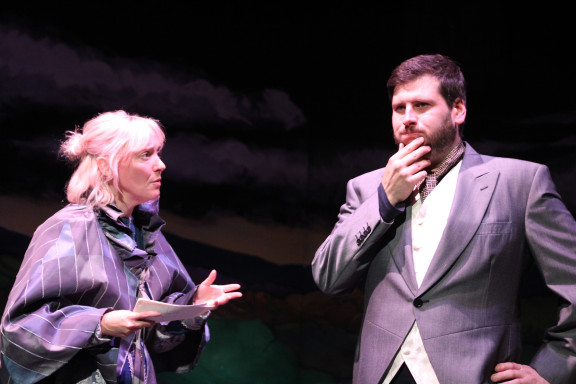
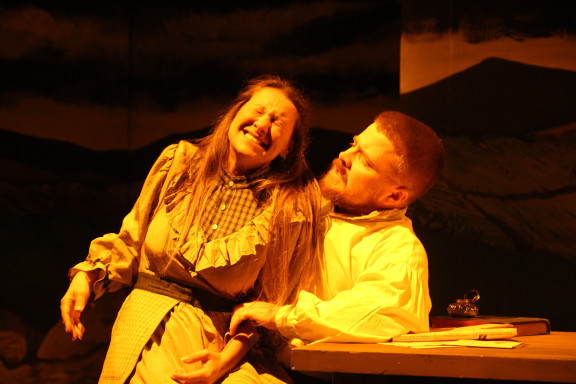
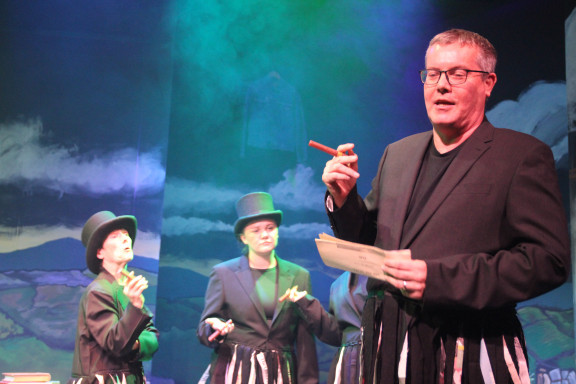
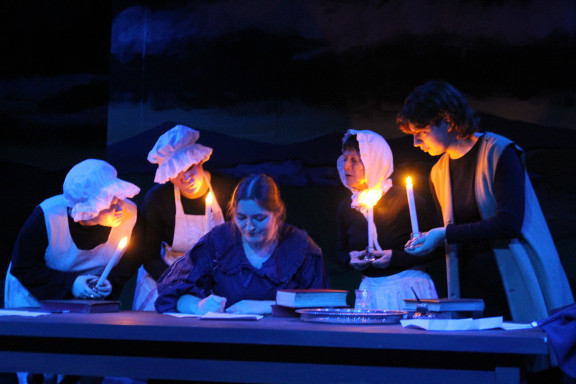
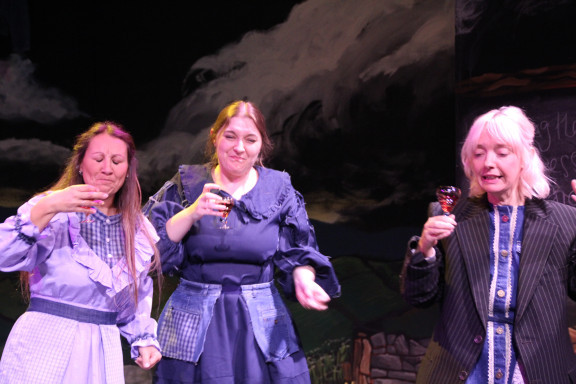
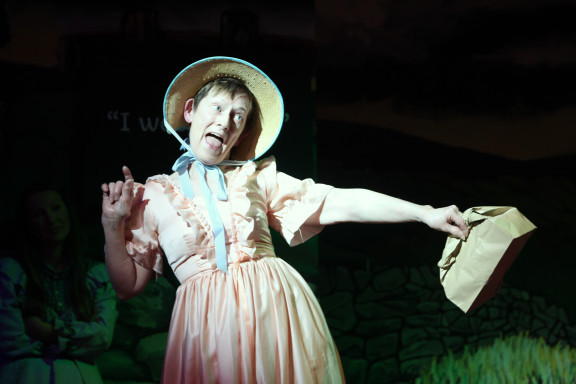
The play is written with a modern sensibility, for example, with contemporary swear words and knowing looks from Charlotte to the audience when Branwell talks about the possibility of his work being in the National Portrait Gallery. In this version, director Anne-marie Greene has fully embraced these anachronistic tendencies with the creation of punk-inspired costumes, reflecting the rebellious nature of the Brontës, whilst still with a nod to Victoriana. There is also a smorgasbord of contemporary music, including various “Little Sister” songs and “It’s Raining Men” by the Weather Girls to which the ensemble do a lively dance. Thus, when Charlotte dances with her publisher it is more of a disco bop than an Austenesque ball.
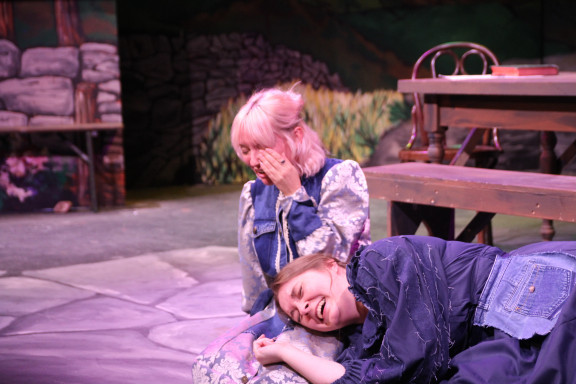
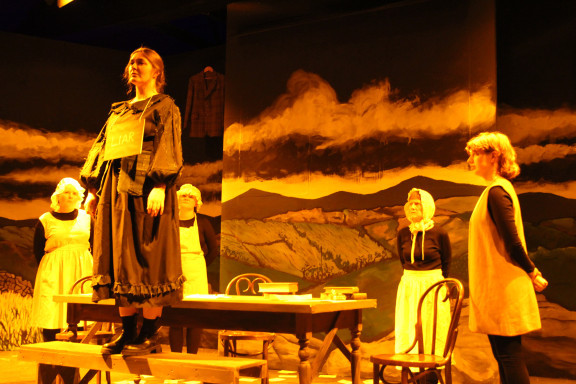
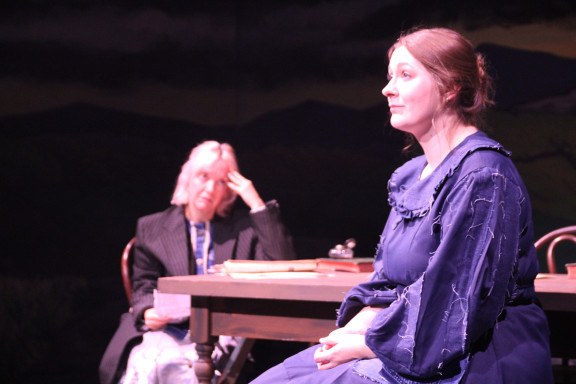
As well as the impressive costumes, the Criterion crew have excelled themselves on both set and props for this production, the former being representative of a flagstone floor and a functionally sturdy parsonage table against a beautifully painted wild Yorkshire moor landscape, and the latter including homemade sugar glass, a giant star shaped pork pie, a lot of paper, and signs wittily demoting the key words in each scene!
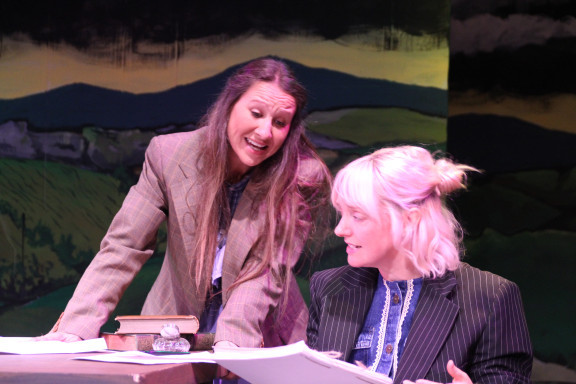
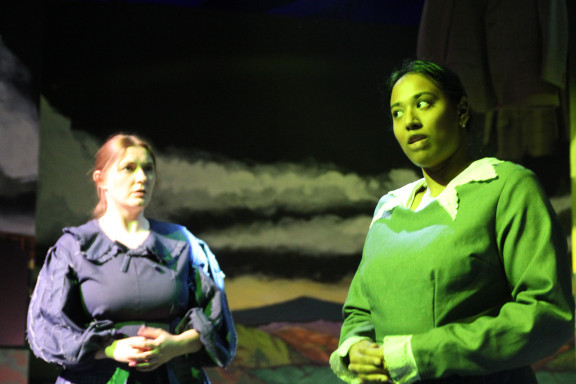
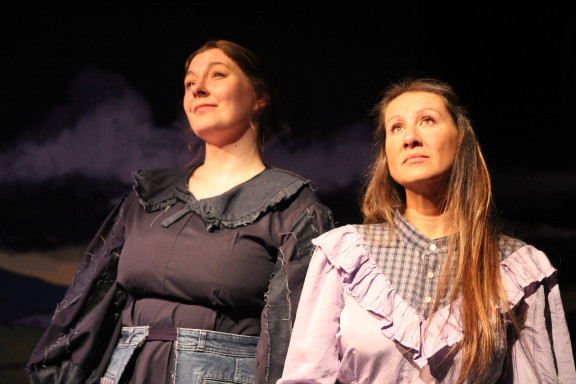
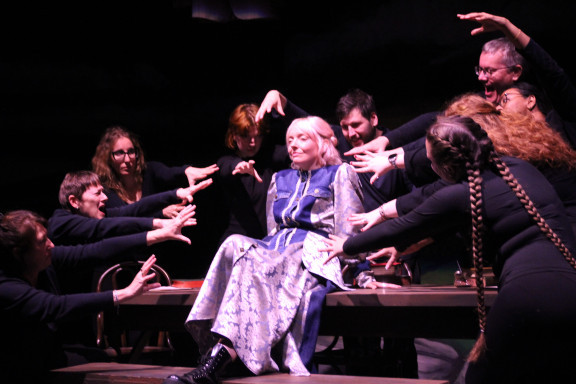
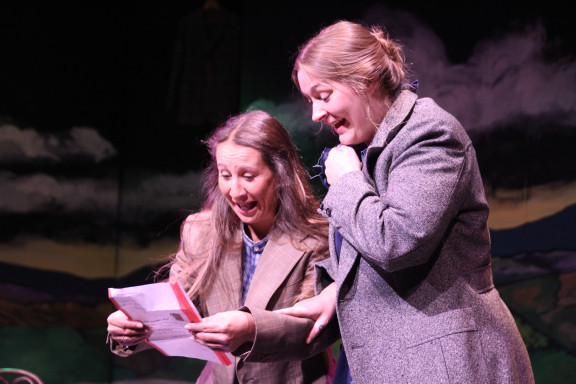
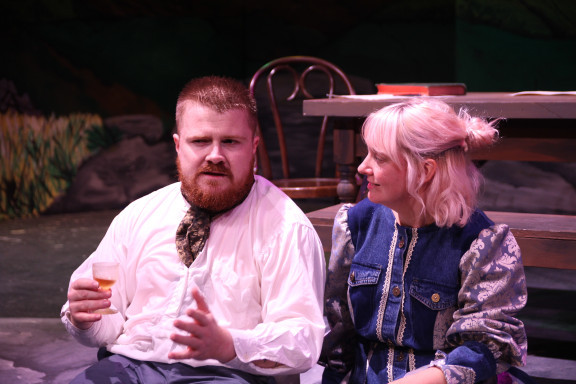
There are strong performances as the Bronte siblings, with Criterion stalwart Alice Scott as a pink haired Charlotte, Nicol Cortese as Emily and Rosie Pankhurst as youngest sister Anne, ably supported by Conor Bailey as drunken brother Branwell. They are all fighting for their passions in a world where they are expected to conform to expectations. The nine strong ensemble show versatility as they switch between a variety of other roles, from child to publisher, from critic to famous author, with some great dance moves along the way.
Though with a deliberate modern twist, this play is strongly based on facts. It makes no claims to historical accuracy, but some facts seem to have been deliberately omitted or glossed over, for example Charlotte’s marriage and pregnancy, and the deaths in infancy of the two oldest Brontë siblings, as well as only a brief mention of the early death of their mother when they were small children. This is possibly down to the desire to debunk the image of them as tragic and, indeed, this play contains a lot of humour and witty lines. It also portrays the sisters as picking their literary pseudonyms with the intention of being thought of as male authors, in this production they put on a male suit jacket as they take on their pseudonyms, whereas real life Charlotte stated that they deliberately picked ambiguous names that could be thought of as male or female. This perhaps is the point of the play and this excellent production, to make us rethink our perception of the Brontës, were they tragic, mousy, religious conformers or fierce, sweary, rebellious, competitive, combative reformers? Perhaps the truth lies somewhere in between and, though the audience may not entirely accept this alternative mythology offered up in this thought-provoking play, they will certainly go home with a desire to read The Tenant of Wildfell Halll and an openness to considering the Brontës in a new light.
Alison Manning, Earlsdon Echo
The Brontë sisters, towering figures of English literature, only wrote seven novels in total but they have been dramatised numerous times in film, TV series and even a hit pop record. The play’s title of Underdog ostensibly refers to Anne. She is perhaps the least well known of the Brontë Sisters if measured by the number of productions of Jane Eyre and Wuthering Heights, written by Charlotte and Emily, respectively, compared to her two novels. How many time have you seen an advert for a production of The Tenant of Wildfell Hall and Agnes Grey? Agnes who?
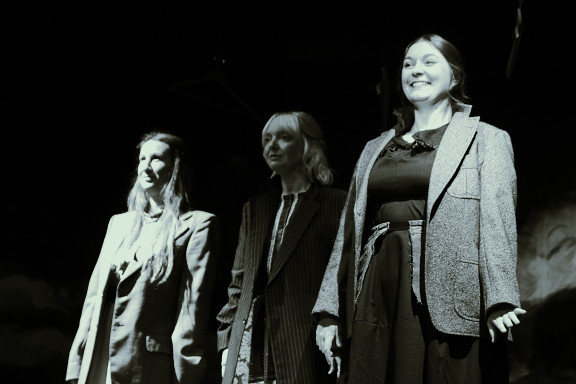
But this is Charlotte’s story. Director Anne-marie gives us a clue in the opening scene, although we don’t realise it at the time, when Charlotte (Alice Scott) alone in the spotlight is surrounded by the admiring ensemble. With sisters Emily (Nicol Cortese) and Anne (Rosie Pankhurst) in the Brontë parsonage kitchen, we hear off stage the raging war of words between feckless brother Branwell (Connor Bailey) and their father who indulges him, while the backdrop portrays the brooding Pennine Yorkshire moors.
Alice builds Charlotte’s persona, subtly at first as she disparages Anne’s idea of becoming a governess to earn some money for the family. Emily bridges the gap between the two sisters, younger sister to Charlotte, and elder to Anne. Nicol gives Emily a gentleness in her dealings with Anne but an increasing feistiness and confrontation when speaking with Charlotte as the story progresses.
Rosie wonderfully conveys Anne’s timidity and apologetic unassertiveness, with stammer to boot, who is bullied even by her employer’s children. Charlotte and Emily have ambitions to be writers but even Anne is driven to write down her painful experiences, and hence the triumvirate of Brontë writers is born. And so is the rivalry between them. Anne’s manuscript is the first to be accepted for publication, followed by Emily’s, but Charlotte is resentful and does not share their joy. Anne pleads with Charlotte to delay publication of Jane Eyre until after her book is published as both plots involve a governess, but Charlotte’s ambition is all consuming.
Alice increasingly builds Charlotte’s self-centredness as she frequently breaks the fourth wall to tell us her truths. Recollections may vary, as someone famously said, but Charlotte has the floor. Alice’s portrayal wonderfully captures Charlotte’s self- delusion and hypocrisy as she ironically accuses Anne of narcissism and bullying.
Charlotte becomes the last surviving sister. She admits that she edited Emily’s poetry and she refused to allow further reprints of Anne’s novel, claiming she wants to defend Anne’s reputation, but it is obviously to enhance her own reputation and diminish Anne’s popularity. Charlotte’s character is finally fully revealed.
Anne-marie uses the ensemble effectively for crowd scenes, although occasionally some did not project their lines well, and the choreography by Deb Relton-Elves was well-rehearsed and fluent.
Although the plot rightly discusses the iniquitous vulnerability and powerlessness of women in society at the time, as the sisters have to initially publish using male pseudonyms and discussion in literary circles that women could not have written works such as theirs, the power of the play lies in the family dynamics, and the characters that each actor portrays. Emily gives a rarely heard view, defending Branwell as being a victim of the expectations that are put on men.
It is important to remember that Sarah Gordon’s excellent script is rather like those ITV true crime dramas, based on known facts but with some licence of what was said by whom, in other words, it’s all true apart from the bits that aren’t. The Criterion has put on a play which is both highly entertaining and thought-provoking and thoroughly deserves the enthusiastic applause.
Charles Essex, ElementaryWhatson
We know the Brontës. The remarkable sisters wrote some of the most significant works of fiction in the English canon. There’s Charlotte (Jane Eyre) and Emily (Wuthering Heights) and…who’s the other one? Oh yes, Anne, who wrote The Tenant of Wildfell Hall. Anne’s book was a wild success when it was first published, though it was later suppressed by sister Charlotte, who’s ruthless desire for recognition as a writer and as a woman writer in an exclusively male-dominated scene almost ruined the otherwise close relationship between the three women, stuck on a lonely moor in Yorkshire and dependent on each other for stimulation and support.
Anne-marie Greene’s direction gives Sarah Gordon’s 2024 already feisty modern-day revision of the Brontëmyth a quick-witted flair. Much of this is due to the clever, knowing portrayal of Charlotte by Alice Scott. She is a pink-haired, elfin dominatrix of the family. Her determination to place herself at the top of the literary tree is expressed by frequent asides through the fourth wall, which draws us onto her side while at the same time slightly repelling us at the unfairness of her treatment of her sisters, Anne in particular. We forgive her, up to a point, partly because of her sparky charm and her knowing comments about the (still) patriarchal publishing game, but also because we buy into her idea that without her there would have been no Brontës. Even Emily, passionately, often angrily played by Nicole Cortese, is sidelined by her.
And what of poor Anne? Anne, the nice one, Anne the modest, self-effacing one who suspends her literary ambitions to become a governess, one of the lowest rungs of the Victorian social ladder, where she is bullied and humiliated by her employers and their nasty children. Somehow, she turns this unhappy experience into a scathing condemnation of abuse within marriage which was revolutionary in her day, and hits the jackpot with her book sales.
But in order to succeed the sisters had to pretend to be men, otherwise they would have been dismissed as mere ‘women writers.’ But this brings a conundrum. By pretending to be men they are, in a sense, beating the men at their own game and are somewhat protected by the mask, provided their true identities remain secret. Once they are revealed they are subject to the very condemnation they challenged in spite of, and because of, their success.
Sarah Gordon’s play doesn't delve too deeply into the books themselves; rather it is the Brontë myth that is explored and its status as a repudiation of patriarchy. Even Branwell Brontë (Connor Bailey), their wayward, drunken brother, who aspired to be a painter though he lacked the talent, is somehow portrayed as a victim of this London-based snobbery. Ironically by working together to create the image of the Bell brothers, partly in order to protect him from full knowledge of himself, the sisters cannot help but buy into that snobbery.
Charlotte tries to rip the façade off the dominant ideology of the time by making herself into a literary superstar and using her fame to overturn the orthodoxy. It is self-conscious promotion with its roots in the past and its flower very much in the present. The cast, including an excellent ensemble, have great fun with it, playing with a punk / Gen Z theme. The performances are top-notch throughout, the three sisters well balanced in their characters, Charlotte as the apex of a triangle that could only function as a collective.
Nick LeMesurier, Warwickshire World