
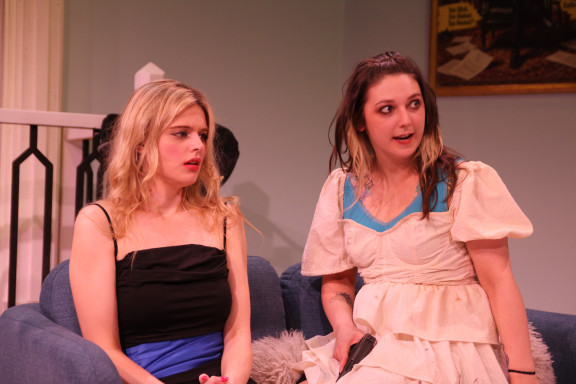
A play adaptation of the best-selling 1996 novel of the same name by well-known comedian and author Ben Elton.
Set against the glimmering backdrop of Hollywood, Popcorn follows acclaimed film director Bruce Delamitri on the night of his Oscar triumph. His celebrations are cut short when two violent intruders — fans who claim his movies inspired their crimes — invade his home.
A sharp, darkly comic thriller, Popcorn interrogates the relationship between art, celebrity, and responsibility in a culture addicted to spectacle and violence.
When Popcorn was first written, it was asking, do violent movies create a violent society? Can minds be corrupted by images and ideas presented in films? In the era of social media this has perhaps more potency: do platforms which are often unregulated, cause any damage and desensitise minds?
'Sugar-coated fury: Ben Elton's hit delivers big laughs and a brutal message" The Evening Standard
"Popcorn is a blast... A breath of fresh air " London Theatre Guide
"Ben Elton tries to tackle a massively controversial subject and succeeds in a script that makes you think incredibly hard about the morals of modern media." The Stage
"An exhilarating, exhausting and relentless comic indictment of a society out of control" The Herald
Please note that this production contains the following:
Strong language. Frequent throughout, including offensive slurs and sexual terms.
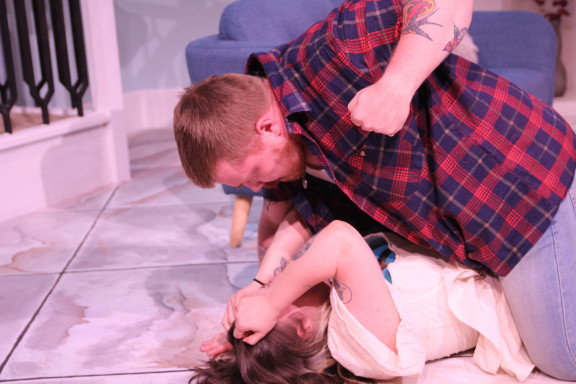
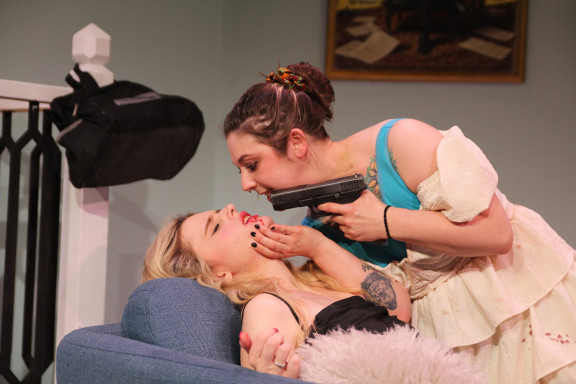
Simulated violence. Hostage-taking, physical threats, and guns used to intimidate people.
Loud gunshot effects. Sudden loud noises (gunshot effects) during Act II.
Mature themes. Adult themes around media violence, celebrity culture, and the sexualisation of crime.
Flashing lights. Camera flashes and rapid light changes in the Oscar / TV scenes.
Age guidance. Recommended for ages 15 and above.
In line with our EDI policy, we undertake an EDI impact assessment of all our artistic programming. This play has no central diversity message. On the character notes, there are indications where specific playing gender identifications are called for and there are also recommendations of approximate playing ages. Otherwise there can be flexibility around casting with regard to ethnicity, age and disability.
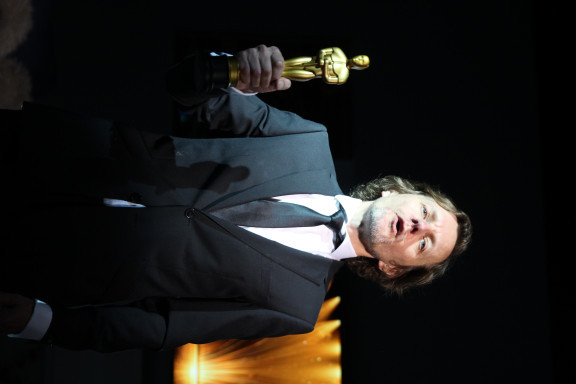
The stage set is the Hollywood living room of film director Bruce Delamitri – played with an incredible American accent by Dave Crossfield. He’s off to collect an Oscar for his films which glamourise violence and make it sexy.
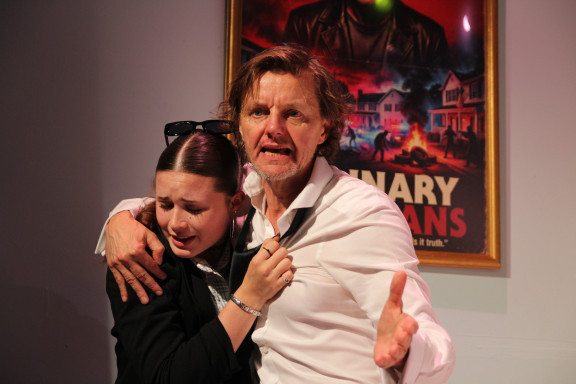
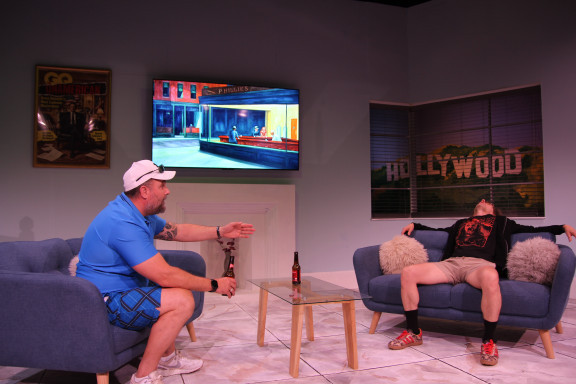
The walls are adorned with AI generated Pulp Fiction style posters for Bruce’s latest blockbuster and in the centre hangs Edward Hopper’s ‘Nighthawks’. It’s a painting about isolation in America, which hints at the unease to come.
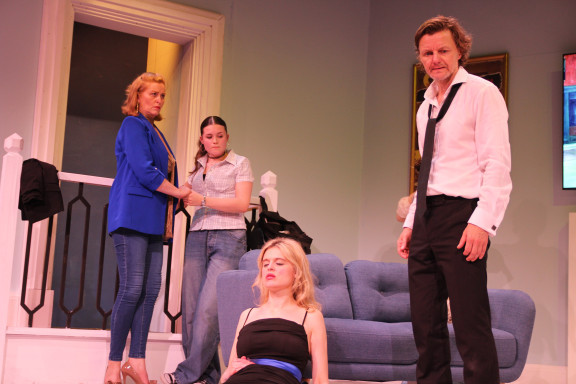
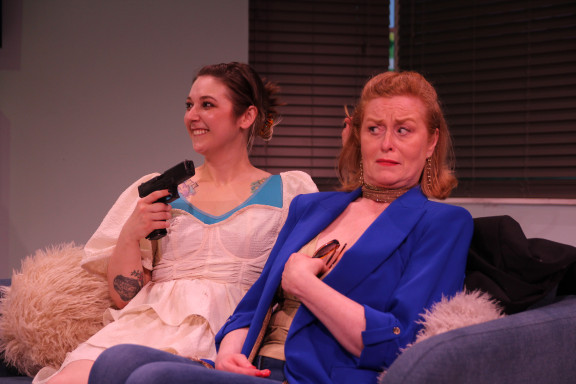
Bruce is arrogant and dismissive of both his wife, Farrah Delamitri played by Donna Davenport and his daughter, Velvet, played by Millie Revill. He is keen to get rid of both of them to bring home not only an Oscar but Playboy Centre-fold Brooke Daniels. Brooke is played enthusiastically by Paige Phelps who is making her debut at the Criterion in this production.
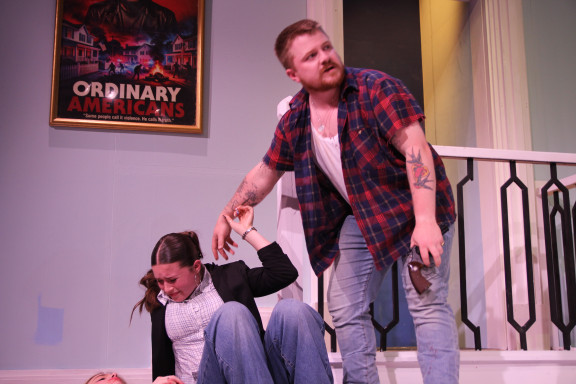
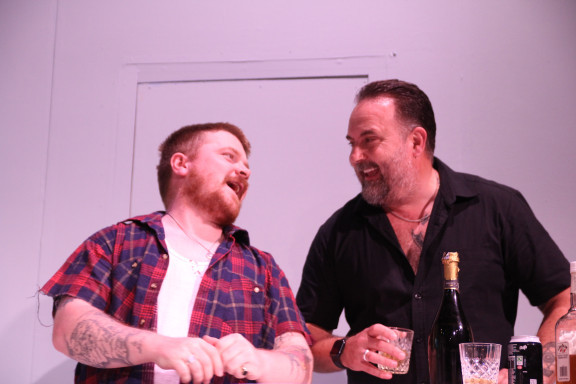
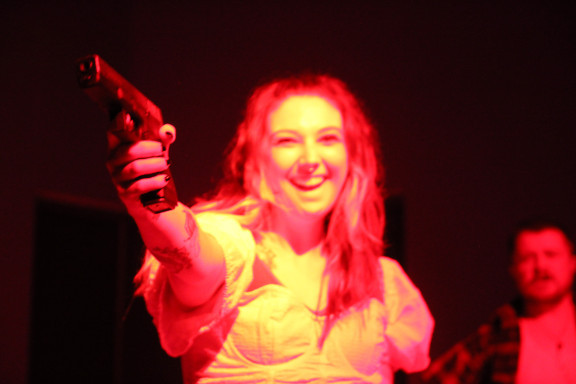
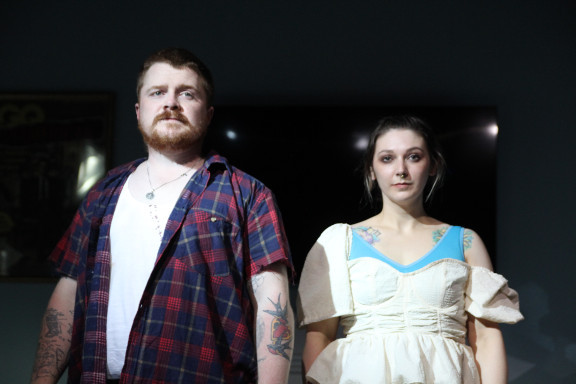
Brooke is a woman out to use her charms to get everything she wants out of Bruce. He caves in just at the point the violent duo the ‘Mall Murderers’ wade in. The rough, tough male half of the duo, Wayne, played skilfully by Connor Bailey, takes charge and the play takes a very dark turn. Connor is utterly convincing as the tattooed Wayne who will casually kill someone simply for the thrill of it.
Wayne and his girlfriend Scout clearly get off on the thrill that their threats of violence lend them. Then they explain their bloodlust is Bruce’s fault. If only he hadn’t made such attractive movies glamourising violence they would have never been on a major killing spree. It’s only fair he confesses to save them all...
The play is very intense, with drama and casual violence throughout. The occasional comic line lifts it, but the actors never break character for a moment. The stand-out performance of the night goes to Wayne’s girlfriend Scout, played by Kelly Davidson. She skilfully mixes lovestruck girlfriend with dumb American and quick-witted criminal. With a simple smile, Kelly displays Scout’s lack of depth of character and somehow you feel like you almost know her.
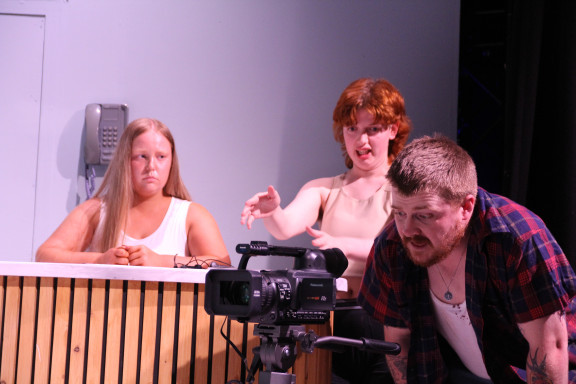
There’s an incredibly clever scene where the actors are also shown live on TV. So we are watching the actors, who in turn are watching themselves - and that’s the whole point, in a social media-driven world where we are all actors and observers, how far will we go to ‘go viral?’
The play asks the very real question ‘Does TV violence encourage real life violence?’ And if so, who is then responsible for this violence? Also, because this is America, who is to pay for that wrongdoing when it’s the lawyers asking the question?
Dark, intense and thought provoking, Popcorn leaves you deeply concerned for the modern world we live in.
Hilary Hopker, ElementaryWhatson
Ben Elton's play, Popcorn, now playing at the Criterion Theatre, Coventry ‘til 4 July is funny, scary and though it is set in star studded Los Angeles, its themes are all too close to home and not a bit dated.
Bruce Delamitri (Dave Crossfield) is a film director, famous for his ultra-violent movies which exploit the worst of human motives. The morning after he controversially wins an Oscar for a cynically titled film, Ordinary Americans, he is first seduced at home by Brooke Daniels (Paige Phelps), a Playboy bunny-cum-wannabe actress, then invaded by two gun wielding psychos, Scout (Kelly Davidson) and Wayne (Connor Bailey). They’ve already gained notoriety as The Mall Murderers, famous for their killing sprees and for the number of random victims they have shot, all the while claiming to be inspired by Bruce’s films. In a clever twist, Wayne has a plan to use their and Bruce’s celebrity status to pull off the ultimate accolade and directly involve the whole viewing public in America in the action. It's a story that could only be believed in a world – our world - in which every event, the more tragic the better, is relayed live and the media plays a blurring role in everyone’s conscience. If we’re watching, aren’t we too, in some way, complicit?
Though the play is a little heavy on message, its and the Criterion’s fast-paced production, provides thrilling entertainment that proves the maxim that no matter how shocking the events, it is the relationships between characters that matter. Dave Crossfield is marvellous as the cynical director, more concerned about his career and image (same thing) even when the lives of his own daughter and wife are at stake. Like a great movie bad guy, you hate him, yet you can’t take your eyes off him. His vampish wife, Farrah (Donna Davenport) is no less focussed on the main chance, that being the divorce settlement she hopes to gain from him.
Crucial to the play are Scout and Wayne, utterly believable as a modern day Bonnie and Clyde, except the originals had some kind of motive in robbing people. Wayne and Scout have no such honour; they just like killing. They also like each other. Theirs is a trailer trash love affair between the bullish Wayne and his ditzy girlfriend. But neither are as dumb as they seem. Wayne is the more rational of the two, able to come up with a weird but compelling plan, while Scout, though subordinate, is both terrifying and endearing in her child-like changes of mood. Hers is arguably the brightest star in a firmament of stellar performances.
Dean Sheridan’s direction ensures that the very quality of the acting and the production are part of the play’s significance. It's all beautifully constructed. Though the characters might be gorgeous to look at and witty in repartee, and so believable when on stage or in front of the camera, they are hollow, narcissistic, greedy, their relationships only as strong as the latest deal. Even the TV crew, Bill (Rowan McDonnell) and Kirsten (Morgan Blundell-Smith) brought in to finish the job and ‘innocent’ employees, are complicit. We look upon them all as strange specimens familiar in profile but not in depth.
The question, does the image reflect reality, or is it the other way around, has never been more pertinent.
NIck LeMesurier, Warwickshire World
The Criterion Theatre’s latest production (on 27 June till 4 July) is Ben Elton’s thought-provoking play, Popcorn, based on his novel of the same name, and directed by Criterion stalwart Dean Sheridan. The action is centred around famous Hollywood movie director Bruce Delamitri, convincingly played by Dave Crossfield, who encounters an equally infamous pair of criminals on the night of his Oscar win, whilst also juggling complex relationships with his ex wife and teenage daughter, as well as aspiring actress Brooke Daniels. The ensuing hostage situation is portrayed with a skilful balance between menace and humour, making the audience jump and laugh out loud in turn.
This is a play that questions the influence of films, television and other media sources. Written in the 1990s, Bruce Delamitri’s “designer violence” films are clearly echoes of the popular violent films of that era, and, increasingly as the play progresses, faced with violent criminal couple Scout (Kelly Davidson) and Wayne (Connor Bailey) who claim to have been influenced by his films, Bruce, the other characters and even the audience are forced to question if it is right to glorify goryness and violence through these films, what the consequences of this might be and who is responsible for them. As well as the specific question of the portrayal of violence, the play also opens up wider media questions, as Scout and Wayne parrot views they have seen on TV and read in newspapers and magazines, giving them an aura of intelligence which is at odds with their seemingly mindless crimes or random shootings. There are also questions over the blurring with fiction and reality in film’s characters, with some great lines about whether Mickey Mouse is real.
The set is simple but effective, depicting a clean, modern room in Bruce’s luxurious home, complete with bar and stylish fireplace. A large TV on the back wall of the stage is used to great effect for multiple purposes. The unusual opening of the play has the stage in darkness, but three characters are there watching a darkly comic scene from one of Bruce’s films. The TV is also used to cleverly portray the golden background for a quick scene set elsewhere, namely Bruce’s Oscar acceptance speech. Towards the end of the play, a small TV crew become involved in the hostage situation, and their footage is projected into a live news report on the TV screen. This adds an extra layer to the questions the play raises about the what is reality, by creating a televisual version of the events in this fictional play inspired by real life fictional films, and thus simultaneously giving the scene greater authenticity, by framing it as a factual news story, whilst also, to some extent, fictionalising its reality by converting it from flesh and blood actors to the possibly questionable medium of television.
Avoiding spoilers about the final denouement in case you get to see Popcorn, which I would recommend, it certainly leaves the audience lots to think about, questioning who, ultimately, holds responsibility and who are the victims and who are the perpetrators.
Alison Manning, Earlsdon Echo